
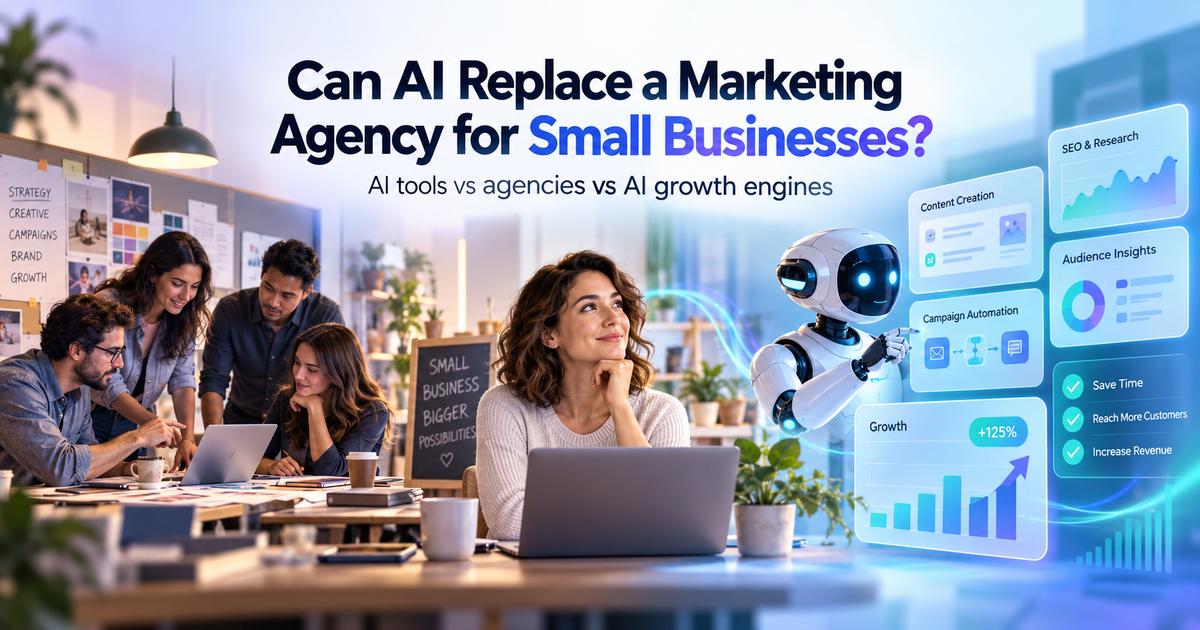

Quick answer: Yes, AI can replace many tasks traditionally handled by marketing agencies, including content creation, research, planning, and analysis. But AI tools alone do not guarantee growth. A coordinated system with continuous experimentation and human accountability is more likely to replace an agency's operating role.
What Does a Marketing Agency Actually Do?
A marketing agency typically handles strategy, content production, campaign execution, performance optimization, and reporting. Agencies combine specialists across research, design, copywriting, media buying, and account management. AI can assist with much of that work, but coordinating it into a reliable growth process is a separate challenge.
Which Marketing Agency Services Can AI Replace?
- Market research: AI can analyze competitors, reviews, trends, and customer signals; humans validate assumptions and context.
- Content strategy: AI can develop campaign ideas and messaging; humans establish priorities and positioning.
- Creative production: AI can generate copy, images, scripts, and video variations; humans check accuracy, quality, and brand suitability.
- Social media: AI can draft and schedule content; people remain important for sensitive conversations and community management.
- Paid advertising: AI can assist with testing and optimization; humans govern budgets, risk, and business trade-offs.
- Reporting: AI can summarize campaign metrics and identify patterns; humans interpret their business impact.
The key distinction is between automating marketing tasks and owning marketing results. Ten generated Instagram posts are not equivalent to a team that identifies an opportunity, launches a campaign, evaluates results, and changes direction.
AI Marketing vs Traditional Agencies: Which Is Better?
Traditional agencies suit businesses needing specialized creative leadership, public relations, complex partnerships, or deep industry expertise. Standalone AI tools can be economical for founders who already understand marketing and have the time to coordinate them. AI growth engines aim to combine connected automation, recurring execution, and human oversight.
When comparing options, consider strategy, content quality, campaign ownership, iteration speed, accountability, total cost, and whether brand knowledge persists between campaigns. No delivery model is universally better.
Why Multiple AI Tools Are Not the Same as an AI Marketing Team
A founder might use ChatGPT for copy, Canva for graphics, an AI video generator for ads, Meta Ads Manager for campaigns, and Google Analytics for measurement. Each tool helps, yet someone must coordinate briefs, approve assets, launch work, analyze performance, and choose the next step.
This is the AI marketing coordination gap: automating individual activities does not automatically create a coordinated operation. Closing it requires shared brand context, connected workflows, defined responsibilities, and a feedback loop between action and results.
What Is an AI Growth Engine?
An AI growth engine coordinates research, strategy, production, execution, measurement, and learning as an ongoing process instead of producing isolated outputs.
- Understand the business, audience, products, competitors, and market.
- Plan growth opportunities and testable campaign hypotheses.
- Create messaging, creative assets, and campaign materials.
- Execute approved activities through the relevant channels.
- Measure results against business objectives.
- Improve the next cycle based on observed performance.
Continuity is the advantage: a system can build on previous experiments rather than restarting from scratch. It still needs good data, integrations, spending controls, and human judgment.
How Tixi Approaches AI-Powered Marketing
Tixi is designed to combine AI teammates, coordinated growth execution, and accountable human operators. Instead of asking owners to assemble and manage disconnected tools, its operating model aims to coordinate marketing around measurable objectives.
AI teammates instead of disconnected tools
Specialized AI capabilities support audience research, content strategy, creative development, and performance analysis within a shared plan.
Human operators for accountability
Human oversight helps review consequential decisions, handle exceptions, and maintain responsibility for execution.
Weekly growth execution
Recurring growth cycles connect planned work with observed performance and the next decisions, rather than delivering disconnected assets.
Learning from actual performance
The system is designed to use campaign signals to inform future experiments. Success for one business never guarantees the same result for another.
Clear spending and approval controls
Owners should understand where budgets go and retain control of consequential financial actions. AI can recommend and carry out work within defined permissions.
When Should a Small Business Replace Its Marketing Agency With AI?
- Your marketing requirements are repetitive, such as frequent promotions, social content, and creative variations.
- You spend too much time briefing, coordinating, and chasing agency deliverables.
- Your budget cannot support a large marketing team, but you still need recurring execution.
- Your knowledge is fragmented across dashboards, spreadsheets, and conversations.
- You want to experiment with offers, audiences, messaging, and creative more frequently.
Do not switch only because an AI subscription looks cheaper. First determine whether the replacement can reliably take over the responsibilities your agency actually performs.
When Should You Keep a Human Marketing Agency?
Agencies can remain valuable for high-stakes positioning, reputation management, complex PR, large offline campaigns, specialized regulatory expertise, and high-touch creative direction. A hybrid approach can reserve major brand initiatives for human specialists while AI supports research, content production, and routine experiments.
How to Transition From a Marketing Agency to AI
- Audit your current agency's actual responsibilities and deliverables.
- Record baseline costs, leads, acquisition costs, conversion rates, and attributed revenue where possible.
- Select one relatively low-risk workflow, such as organic content or competitor research.
- Test AI-supported execution and compare quality, workload, turnaround time, and outcomes.
- Retain approval controls for spending, public claims, sensitive messages, and important decisions.
- Expand only when the new process demonstrates acceptable reliability and measurable value.
Frequently Asked Questions
Can AI completely replace a digital marketing agency?
AI can automate many recurring tasks. Whether it can replace the full agency depends on strategy complexity, integrations, quality requirements, and the need for human judgment.
Is AI marketing cheaper than hiring an agency?
Often some production work costs less, but total cost includes subscriptions, usage, advertising spend, integrations, oversight, and quality assurance. Compare total operating cost, not software price alone.
Can AI run Facebook and Instagram ads automatically?
AI can help create ads, analyze audiences, propose tests, and optimize campaigns. The level of automation depends on the product, platform access, and permission controls.
Is AI marketing suitable for local businesses?
Yes. Restaurants, salons, clinics, retailers, and service businesses can use AI for promotional content, local research, campaign planning, and customer communications. Results depend on demand, offers, channels, and execution.
What is the difference between an AI marketing tool and an AI marketing agent?
A tool usually completes a requested task. An agent can pursue a defined objective through several steps using permitted data and tools, sometimes with human approvals.
Will AI marketing guarantee more customers?
No. AI can improve efficiency and support faster testing, but customer demand, pricing, product-market fit, creative quality, and campaign economics still shape results.
Final Verdict: AI Can Replace Agency Work, but Accountability Still Matters
AI makes research, creative work, and campaign management more accessible to small businesses. But producing more content is not the same as growing a business. The opportunity is to connect strategy, execution, measurement, and continuous learning while keeping humans responsible for important decisions.
For busy founders, an AI growth engine with human oversight is an alternative worth evaluating. Explore Tixi at https://www.tixi.ai/ to learn about its approach to AI teammates and coordinated growth execution.
References
- Google Ads: AI-powered advertising solutions — https://ads.google.com/home/campaigns/ai-powered-ad-solutions/
- Google Search Central: AI features and your website — https://developers.google.com/search/docs/appearance/ai-features
- Tixi — https://www.tixi.ai/